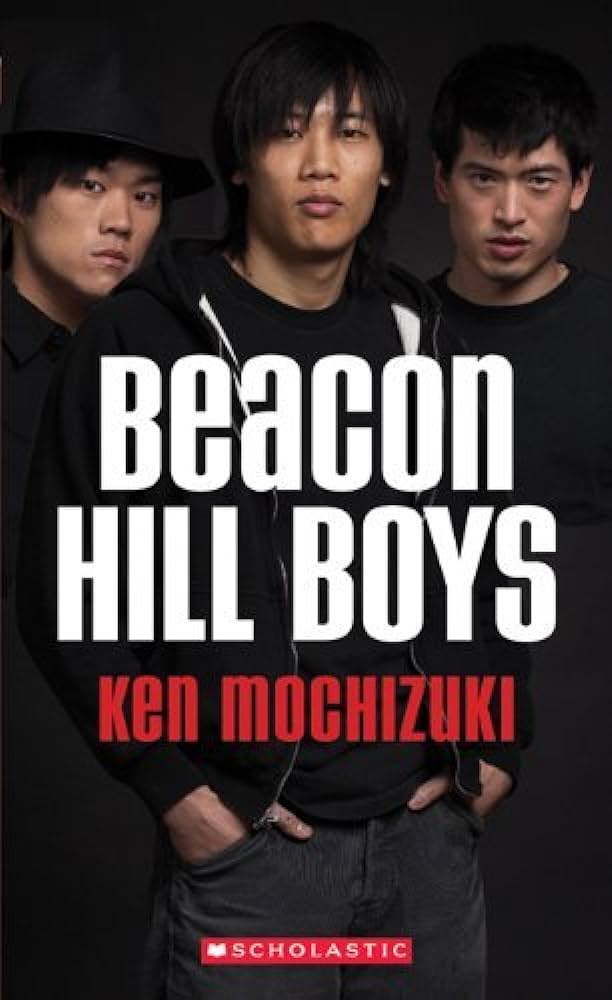
Summary: Set in 1972, Japanese American Dan Inagaki is a high school junior in Seattle and America is in an upheaval. The Vietnam war is still going on and Dan and his three fellow Japanese American “Beacon Hill Boys” are worried they might be drafted. Drug use is rampant. Old institutions and people are being questioned and challenged. Dan admires the African American “Black Power” movement and tries to initiate the same self-pride for the Asian American students at his high school during a time when they were fighting against being called “Oriental.” Dan and his guy friends then embark on a quest for some aspect of themselves and their heritage that they can be proud of besides being part of the “model minority.”
“This novel conveys the early seventies largely through the delicious music that makes life bearable for Dan and his friends; a discography at the end of the book makes it possible for readers to create their own soundtracks … While Beacon Hill Boys is aimed at teenagers, this reviewer, who was Dan Inagaki’s age in 1972, was moved and inspired thirty years later by Ken Mochizuki’s story of everyday heroism.” – The Asian Reporter
“… the author nicely balances universal experiences of male adolescence – confusion about girls, parental expectations, pressure to do drugs, building a family of friends – with scenes that bring readers right into the complicated era, and his important, thought-provoking story asks tough questions about racial and cultural identity, prejudice, and family.” – Booklist
“Mochizuki evokes the period well … the author’s understanding of teen conflicts and the need to forge an individual identity should resonate with a broader audience.” – Publishers Weekly
“Beacon Hill Boys is aimed at young adults, but it isn’t kid stuff. Race is a major topic, and Mochizuki deals with its complexities honestly.” – Jerry Large, The Seattle Times columnist
The story that started me off as a writer (see “About Ken”)! I once remarked at an elementary school in Michigan that Beacon Hill Boys took me a total of 21 years to write (on and off with the picture books in between). A teacher told me afterward that one of her students turned to another and said: “Forget writing – it takes too long!” Just for me it did with this particular book.
Toward the end of the ‘90s, my agent, Rosemary Stimola of Stimola Literary Studio and Liz Szabla, who had moved on to become editorial director at Scholastic Press, suggested that I could turn Beacon Hill Boys into a Young Adult novel. But some sacrifices would have to be made in order to convert it from its adult novel form, namely elimination of a lot of the sex, drugs and four-letter words. Rosemary suggested I read some of the books by Walter Dean Myers, who wrote often of African American inner-city life, yet without a single four-letter word, although the stories and dialogue still retained their power. I tried for that in subsequent drafts, and my agent was right – I didn’t miss those words, but it is as if they are still there.
There are a number of themes running through Beacon Hill Boys, but I would say that one of the most prominent is that it is about the birth of the “Asian American” identity and why it needed to be established.
 Ken Mochizuki